top of page

News

Search

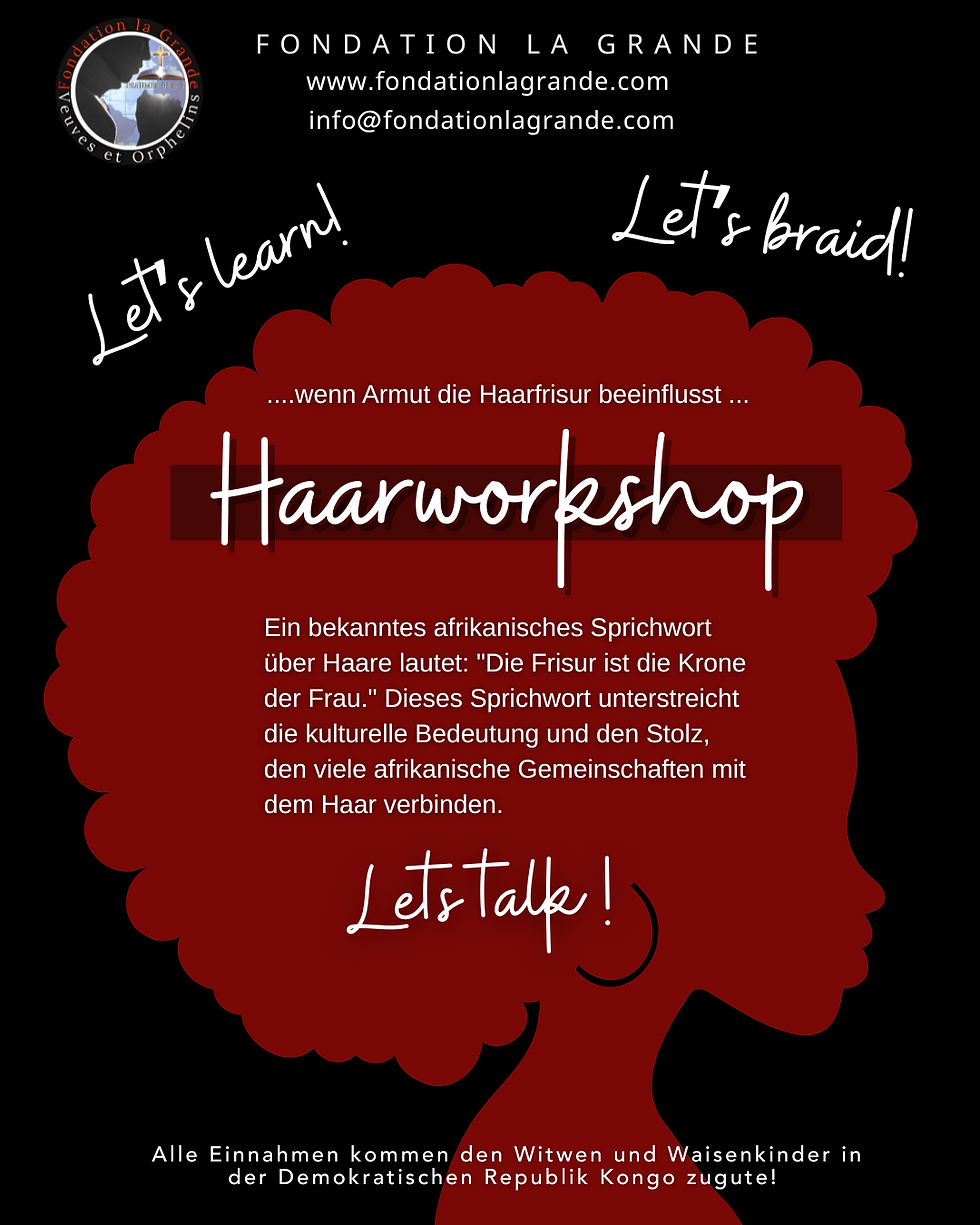
In a world where poverty affects many facets of life, hair care is often an overlooked aspect. The Fondation la Grande has addressed this issue and, with its hair workshop, offers a platform to discuss the deeper meaning of hair and hairstyles. The workshop is not only a place for learning and creativity, but also a means of raising awareness of the needs of widows and orphans in the Democratic Republic of Congo.


On May 24, 2025, twenty curious and open-minded participants gathered at the Africa Institute in Vienna to participate in a unique workshop hosted by the Fondation La Grande. This event was sponsored by the Austrian Student Union (ÖH) Vienna.


A space for openness and honesty

With openness, honesty, and a great deal of courage, the do's and don'ts of dealing with African hair were discussed. The differences in hair texture, the challenges of post-colonial hair care, and the psychological effects were discussed in depth. Particular attention was paid to the daily and seasonal challenges that parents with children face when caring for curly hair. Many questions from the participants were answered in this context.


The importance of self-love

The workshop emphasized the important connection between body, hair, and psyche. It was emphasized that people of African descent, especially in the corporate world, have the right to set boundaries and not talk about their hair in order to protect it from unwanted attacks. The importance of communicating these boundaries was also emphasized. Workshops like this one, conducted by Fondation La Grande, are crucial and open to everyone to address precisely these topics and encourage those who are open to others and answer their questions in their daily, private, or professional lives.


Practical experiences and gratitude

After an enriching exchange, the participants had the opportunity to learn how to weave. This practical exercise was not only educational but also a lot of fun. Special thanks go to the Vienna Students' Union and all participants who contributed to a successful afternoon with their courage, openness, and willingness to learn. The visionary and founder of the cultural and aid organization la Grande/Fondation La Grande treated the participants to delicious Mikate à la Grande (vegan).

This workshop was an important step in raising awareness and appreciating the beauty and complexity of African hair. Thank goodness for this successful and encouraging afternoon!


Charity Gospel Show - No. 8
November 29, 2025, 4:30–8:30 p.m.VHS Großjedlersdorf
Register Now


On the evening of May 3, 2025, an insightful and moving panel discussion on the humanitarian crisis and refugee movement in the Democratic Republic of Congo took place in the heart of Vienna.

The event attracted numerous participants who were interested in and committed to the complex and often overlooked situation in the region.


Event highlights

Welcome and introduction

The event began with a warm welcome from Sarah Grünberger, moderator of the cultural and aid organization La Grande. She introduced the Fondation La Grande, founded by the visionary evangelist La Grande Mbamba, and Congo Vienna Action – two organizations actively contributing to improving the situation in Congo.


Panel discussion

The panel discussion with panelists Topoke Mwana Mayi, Laurène, and Maman Claudine offered valuable insights into various aspects of the crisis. This was complemented by impressive short presentations by Maria B. Canaan representing the Palestinian movement and Isharaga Mustafa Hamid representing the Sudanese. Both speakers spoke passionately about the parallels between the conflicts in their regions and the situation in Congo, emphasizing the importance of international solidarity.

Discussion points

A central theme of the discussion was the dramatic humanitarian crisis in the Democratic Republic of Congo and the resulting refugee movements. Particular focus was placed on the fate of those unable to flee, such as widows and orphans. These groups, often victims of violence, oppression, and exploitation, are increasingly finding themselves on the streets of cities. The moderator emphasized the urgent need to provide support to these vulnerable groups by creating safe havens that offer them protection and hope for the future.


The panelists also answered questions about the root causes of the socio-political situation in the Democratic Republic of Congo and the historical role of the international community in this context. The discussion also highlighted the challenges faced by people who have to remain in the crisis regions, particularly in Goma and Bukavu. Closed airports and travel routes blocked by militias make escape virtually impossible. It was emphasized that international support and the active role of the diaspora are crucial to finding sustainable solutions for those trapped in the Democratic Republic of Congo. The mental health of those affected, the complex causes of the crisis, and the necessary international measures were also intensively examined.


Dinner and networking

The evening concluded with a shared dinner, providing an opportunity to continue the discussions in an informal setting and network. Participants exchanged ideas and sought concrete ways to work together to resolve the crisis.


Conclusion

The panel discussion was a significant step toward raising awareness of the complex situation in Congo and connecting people committed to bringing about change. By connecting history, current challenges, and solutions, a comprehensive understanding of the situation was created. The event encouraged those present to continue actively supporting the affected population, especially widows and orphans, and to find new ways of working together.


Vienna

On April 26, 2025, FLG organized a Congolese cooking workshop for approximately 20 participants as part of the Vienna Students' Union's "Black History is every month" project . The day began with a pick-up of the guests at the train station in Vienna's 21st district, followed by a brief introduction to Congolese culture.


In the early afternoon, the culinary journey of discovery began in the kitchen, where our talented head chef warmly welcomed the participants. After a friendly welcome and introduction by the head chef, we immersed ourselves in the fascinating world of Congolese cuisine. The participants learned about typical ingredients and their optimal preparation.


The focus was on the preparation of the traditional bean stew, often served with rice, cassava, or fufu. Participants gained insights into the essential staples of Congolese cuisine: fufu and rice. They also sampled mikate, the popular fried dough balls.


The meals we prepared together were enjoyed, and the participants shared their experiences and impressions. We summarized the key points and offered space for questions and feedback to optimize the course for future participants.

The workshop not only offered culinary insights, but also promoted cultural exchange and a sense of community among the participants.


Challenges and diversity of nutrition in the Democratic Republic of Congo

The diet in the Democratic Republic of Congo reflects the country's cultural diversity and natural resources. Nutrition often presents a challenge for poor widows and orphans. Below is some information about typical foods in these communities:

staple food

manioc

Cassava is a staple of the Congolese diet. The root is often processed into fufu, a type of porridge that serves as a side dish to many dishes. In rural areas, cassava is an essential source of energy.

rice

Rice complements many meals and is particularly popular because it is filling and can be bought in larger quantities.


Typical dishes

Madesu (bean stew)

Bean dishes like madesu are rich in protein and often served with rice or cassava, providing a cost-effective way to meet daily nutritional needs.


Pondu (leafy vegetables)

Pondu, made from cassava leaves, is a traditional dish eaten regularly. It is rich in vitamins and minerals and is often complemented with fish or meat.


Challenges and creative solutions

Food shortages

Food shortages are a constant problem in many low-income households. People's creativity and adaptability often lead them to find innovative ways to make a lot out of little, for example, by collecting

wild plants.


Community support

Community gardens and local markets play a key role in food security. They provide access to fresh ingredients at affordable prices and promote food sharing.


Nutrition initiatives

Organizations and projects like the workshop supported by FLG and the Vienna Student Union (ÖH Wien) provide education and support, raising awareness about the needs of vulnerable populations in the Democratic Republic of Congo. Such initiatives are crucial for bringing about long-term positive change and improving living conditions.


We would like to thank the initiators and participants for the wonderful afternoon and the generous donations.


Digital handout:


Panel discussion - DR. Congo Humanitarian Crisis & Refugee Movement!
May 3, 2025, 6:00–9:00 PMVienna
Register Now


Charity Gospel Show - No. 8
November 29, 2025, 4:30–8:30 p.m.VHS Großjedlersdorf
Register Now


bottom of page